
Backend Engineers solve complex, invisible problems. Your resume needs to make that backend complexity understandable and highly impressive to both engineering managers and technical recruiters. You must highlight the stability and scale of the infrastructure you've deployed.
Strong backend developer resumes heavily feature metrics related to scale. Did you reduce server latency by 500ms? Did you optimize a SQL query that processes 4 terabytes of data daily? Did you architect a microservice architecture capable of handling 50,000 concurrent websocket connections? These are the keywords technical recruiters search for.
A tech-focused, clean CV layout works best here. Our tech-startup template allows you to list your vast technical stack prominently in a sidebar while giving massive space for your heavy, data-driven bullet points under your work experience.
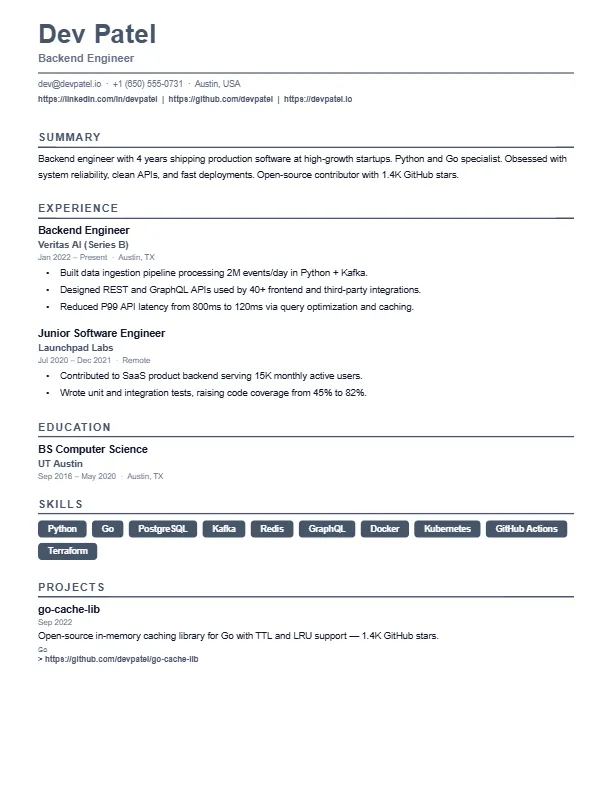
Specify database query optimization wins: response time before/after, number of rows processed, or latency improvements in milliseconds.
Mention your experience with high-availability architecture: uptime SLAs, failover strategies, and disaster recovery planning are green flags.
Show your incident ownership: on-call rotation, MTTR improvements, and post-mortem documentation signal engineering maturity.
Cloud certifications (AWS Solutions Architect, GCP Professional) significantly increase shortlisting rates for backend roles.
Sample professional summary — adapt this to your own experience
“Backend Engineer with 5+ years building distributed, high-throughput systems in Python, Go, and Node.js. Architected event-driven microservices on AWS handling 40M+ daily API requests with 99.98% uptime. Expert in relational and NoSQL database optimization, Kafka message queues, and Kubernetes-based deployment pipelines.”
Pro tip: Replace the specifics with your own numbers, technologies, and company names. Keep it to 2–3 sentences and place it at the very top of your resume, immediately below your contact information.
Every strong Backend Engineer CV includes these sections, structured in this order to maximise ATS parsing and recruiter readability:
Applicant Tracking Systems (ATS) scan your resume for specific keywords. Include these hard and soft skills if they match your experience — and mirror the exact terminology from each job description you apply to.
Pro tip: Copy the exact phrasing of skills from the job description into your resume. ATS systems often match on exact strings — “Project Management” and “project mgmt” may score differently.
Follow this proven structure to build a resume that passes ATS screening and impresses hiring managers in Technology.
Open with 2–3 sentences that highlight your years of experience as a Backend Engineer, your specialisations, and your single most impressive measurable achievement. Avoid generic phrases like "results-oriented professional" — be specific.
List your hard and soft skills relevant to Backend Engineer roles. Mirror keywords directly from the job descriptions you are applying to. Include tools, platforms, and frameworks by their full names.
Use the CAR formula: Challenge → Action → Result. Replace task descriptions with outcomes — metrics, percentages, revenue figures, or time saved. Every bullet should answer "so what?"
Include your highest relevant qualification and any industry certifications valued in Technology hiring. List in reverse-chronological order. Include GPA only if it is 3.5+ and you are early in your career.
Select a layout that matches the visual expectations of Technology recruiters. Use our recommended templates below and export to PDF for consistent, pixel-perfect rendering across all ATS platforms.
While the featured design above is our top pick, these alternative ATS-friendly layouts also perform exceptionally well for Backend Engineer applications.
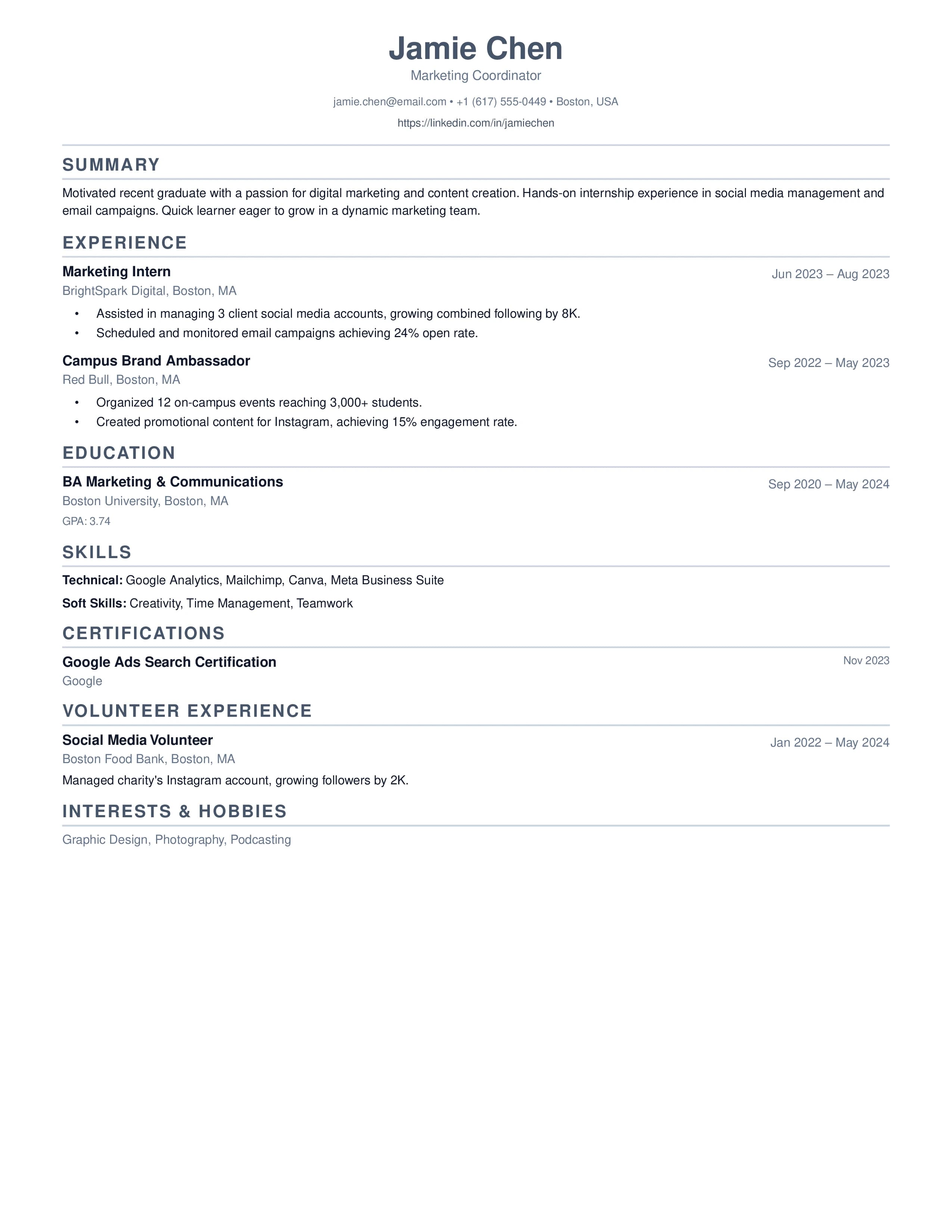
ATS-optimised for Backend Engineer roles.
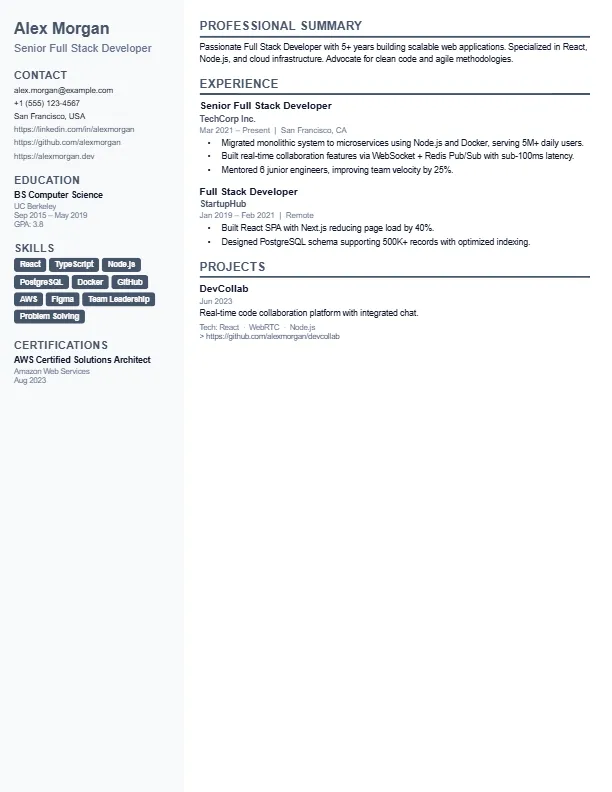
ATS-optimised for Backend Engineer roles.
Join thousands of professionals who have landed their dream roles using our ATS-optimised builder and premium templates — completely free.
Create Free Resume / CV